Literature Monitoring
Automation
Compliance First, AI Enabled
Turning Literature into Actionable Safety Insights
Identifying New Safety Signals
Literature search helps to identify new safety signals or adverse reactions associated with medicinal products that may not have been previously reported.
Supporting Signal Detection
Literature search provides valuable data to support signal detection activities, enabling pharmacovigilance teams to prioritize and investigate potential safety concerns.
Informing Regulatory Decisions
Identifying and categorizing named entities (e.g., people, organizations, locations) Literature search and monitoring inform regulatory decisions, such as label updates, risk management, plan development, and product recalls.
Features
Defining Search Parameters
Define search parameters, including databases, search terms, and time frames, to ensure a comprehensive and targeted search.
Searching Databases
Search various databases, such as PubMed, Embase, and Scopus, to identify relevant articles.
Screening and Filtering
Screen and filter search results to identify articles relevant to the medicinal product or safety concern.
Assessing Article Relevance
Assess the relevance of articles based on predefined criteria, such as study design, population, and outcome measures.
Extracting and Analyzing Data
Extract and analyze data from relevant articles, including adverse reaction information, study results, and study limitations.
Reporting and Documenting
Report and document literature search findings, including any identified safety concerns or signals.
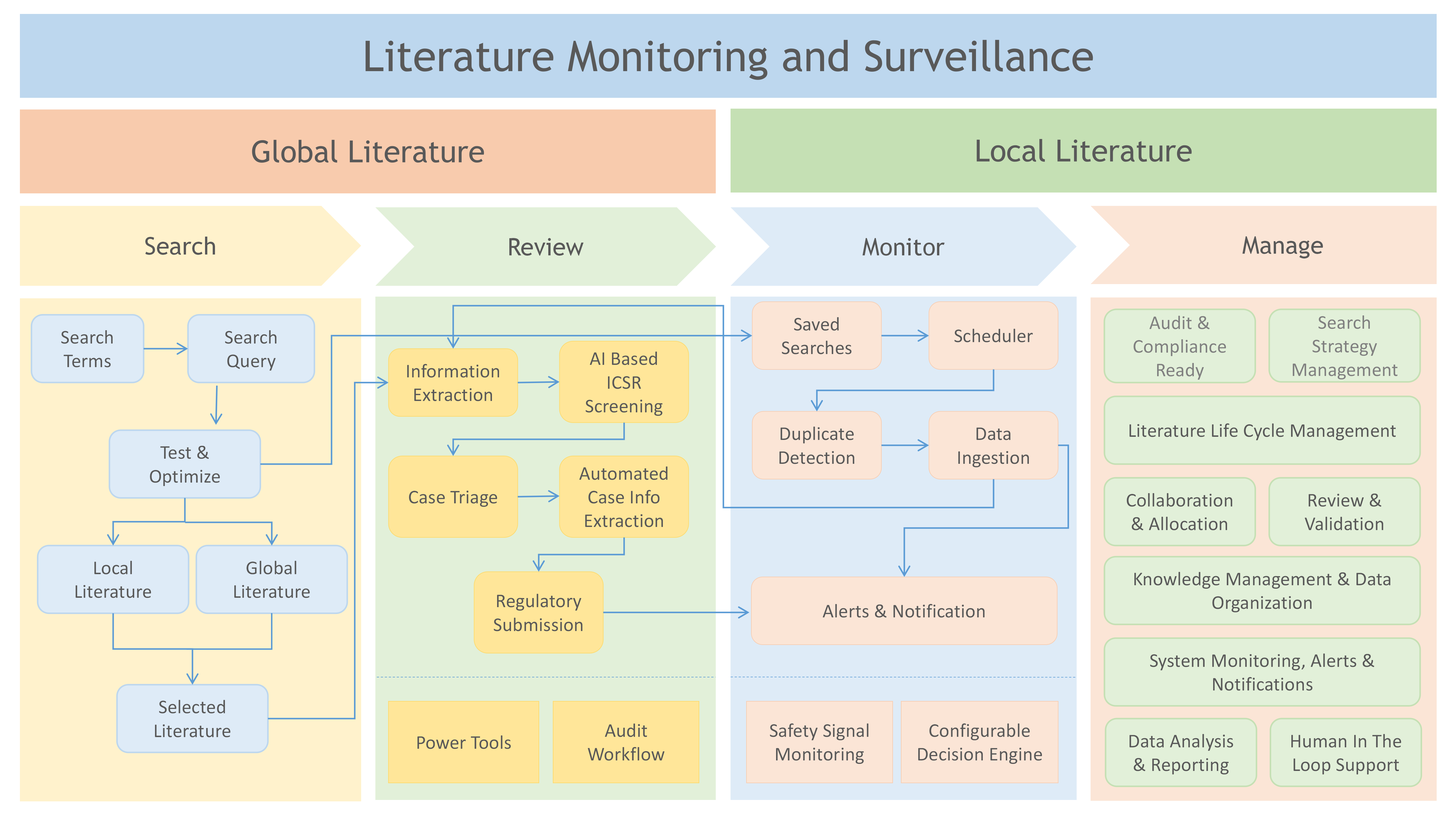
Literature Monitoring & Surveillance Features
Literature Search
- Search Query Construction
- Saved Searches
- Supports all types of Queries
- Filtered and Federated Searches
- Global Search from single page
- Indexing Engine for Local Literatures
- User Defined Local Search Collections
Literature Review
- Full-Text Literature Review
- AI-Based Information Extraction
- Four Minimum Criteria Validation
- Automated Screening & ICSR Detection
- Case Detail Extraction
- Additional Powertools for Annotation
- AI-Powered Literature Quality Assessment
Literature Monitoring
- Continuous Monitoring & Data Ingestion
- Automated Search Scheduling
- Duplicate Identification
- AI-Powered Configurable Decision Engine
- Safety Signal Monitoring
- AI-Based Duplicate Identification
- System Monitoring, Alerts & Notifications
Literature Management
- Audit & Compliance Ready
- Literature Source Management
- Case Lifecycle Management
- Collaborative/Review Support
- Knowledge Management & Data Organization
- Data Analysis & Reporting
- Human-in-the-Loop Support
Global Literature Monitoring
Continuous surveillance of international scientific publications to identify potential safety info related to medicinal products.
Global Literature Sources
(Not Limited to)
- PubMed / MEDLINE
- Embase
- Scopus
- Web Of Science
- Cochrene Library
- Clinical Research Publications
Multi-Database Search
Simultaneous monitoring of multiple global scientific databases to ensure comprehensive literature coverage.
Automated Search Strategy
Configurable search strategies automatically run across global literature sources on defined schedules.
AI Screening
Artificial Intelligence automatically screens publications to identify safety-relevant literature with precision.
Deduplication Identification
Advanced algorithms automatically remove duplicate records across multiple databases for clean results.
ICSR Detection
AI identifies potential Individual Case Safety Reports (ICSRs) from scientific literature automatically.
Automated ICSR Data Processing
Our AI-Enabled ICSR processing engine extract all the relevant information and generate E2B R3 XML files in minutes.
Local Literature Monitoring
Focused identification of safety information published in regional journals and country-specific publications not limited to National Medical Journals, Local Language Publications, Regional Conference Abstracts.
Regional Journal Monitoring
Monitoring national medical journals and regional publications for country-specific safety data.
Local Regulatory Compliance
Tracking government health bulletins and local regulatory literature requirements per region.
Multilingual Processing
Advanced multilingual processing to handle local language publications and regional abstracts.
Country-Specific Surveillance
Regional adverse event detection and local safety signal identification per country.
AI Capabilities
Our framework delivers a structured, AI-Powered pipeline that automates the complete lifecycle of literature monitoring - from intelligent search to safety intelligence using advanced artificial intelligence and NLP models.
Literature Discovery
- Search Strategy Management
- AI-Powered Query Builder
- Automated Scheduling
AI Literature Screening
- Relevance Classification
- AI-Powered Screening
- Multi-Case Identification
Safety Detection
- ICSR Identification
- Seriousness Assessment
- Full-Text Review
ICSR Processing & Data Extraction
- Patient/Reporter/Drug/Event Extraction
- Case Validation & Triage
- Literature-to-Case Linking
Safety Intelligence & Regulatory Reporting
- Safety Signal Monitoring
- Alerts & Notifications
- Regulatory Reporting Support
Compliance First Platform
The Compliance First Platform in pharmacovigilance embeds regulatory adherence into every process to safeguard patient safety. It delivers transparent, auditable workflows that ensure trusted oversight of drug safety monitoring.
Audit Ready Software. Every action is recorded as per the audit requirements and always ready for auditing.
All Major Regulatory Compilance. Multi-Country, Multi-Regulatory support. Periodic updates of the guidelines.
Secure Data Processing & Storage. SSH, Database Encryption, Multi-Tenant, HIPAA, SOC2.
21 CFR Part 11& EU GvP Compliant. The platform is assuring the reliability of electronically produced records and signatures.
Seamless Integrations. Smarter Safety.
Seamlessly connect with leading pharmacovigilance systems and data formats
 Oracle Argus
 ARISg
ARISg
 Veeva Vault
 Excel & CSV
 E2B R3 XML
 Databases
Benefits
AI First Approach
Leverage AI-driven Search & Monitoring to screen global scientific databases, ensuring comprehensive and continuous literature coverage.
End-To-End Automation
Streamlined workflows through complete automation, reducing errors and increasing productivity without any manual touch.
Faster Onboarding
Accelerating the client onboarding process through streamlined workflows, automation, and standardized procedures.
Accuracy Guarantee
Achieve high precision in literature screening and adverse event detection with AI-assisted processing and validation.
Cost Effective
Reduce operational costs by minimizing manual effort, optimizing resources, and improving overall productivity.
Build For Your Needs
Our approach lets you customize our solutions to fit your unique customer requirements.
Manual Monitoring vs AI Monitoring
See the difference automation makes
Ready to streamline your Pharma Operation?
Start your free trial today